The Real Dirt at Luscher Farm

Posted by LindaB on Thursday, January 14, 2010

It is silly to be infatuated by potting soil, but we are. Thanks to Dave Andrews and the magicians at Pro-Gro Mixes & Materials, FRCC now has eight yards of our custom blended potting soil, perfect for clematis in containers. When the collection was housed at Gutmann Nurseries, the generous Bob Gutmann allowed Brewster and his volunteers to experiment with soil blends, using raw materials the nursery kept on hand.

Brewster suggested we blend our own mix after getting a shipment of happy little clematis plants from LaPorte Avenue Nursery in Ft. Collins, CO. The plants, mostly Colorado natives, arrived in a gritty soil with amazingly well developed root systems. It occurred to Brewster that most clematis would enjoy a coarser soil mix, and that such a mix might hold up better than regular potting soil, which starts to degrade and acidify, becoming “wet chocolate cake”, after only a year or two.

Gutmann’s basic potting soil from Pro-Gro is the #9B blend, containing some bark, pumice and a touch of peat moss. Our favorite blend (pretty much perfected by volunteers Rick Meigs and Sharon Kaito) starts with 50% Pro-Gro #9B, to which we add: 25% pumice (chunks the size of kitty litter), 15% coir fiber (coconut fiber), and 10% washed sand. The resulting alchemy is gritty and sturdy, not light and fluffy, and if I were clematis roots, I would love winding my way through it. Imagine stretching and having your back scratched at the same time, while being comfortably moist but not drowning. Mmmm…

FRCC now uses this soil blend for all of our potted clematis, including those we sell. We have also started using this soil in our “weaning” blend, the soil that newly rooted cuttings are moved into when they come off the perlite. Our weaning blend is now 33% coir fiber, 33% perlite, and 33% our potting soil. This is topped with 1/4 inch of #2 poultry grit, to keep the soil surface clean and move water away from developing crowns. (Don’t use the finest, #1 grit, as it has fine particles that can form a crust on the soil surface.)

If you have a nursery in the Willamette Valley or SW Washington, and need custom blended soils, let us recommend the folks at Pro-Gro. And if you need a lot of good soil for growing clematis in containers, just call ‘em up and ask for the Rogerson Clematis Collection mix. Visit their website,
www.pro-gromixes.com for more information.

Propagation From Cuttings: How We Do It

Posted by LindaB on Tuesday, October 20, 2009

Here at the Rogerson Clematis Collection we have a lot of combined experience in clematis propagation. Our board President, Sally Geist, is a long time practitioner of clematis propagation by semi-hardwood cuttings and from seed. Of course we have Brewster’s experience to draw upon, and in the summer of 2008 we had an avid intern who tried many methods and media. Sally and I learned even more on our visit to Japan with the International Clematis Society, also in the summer of ‘08. Sometimes tricks are needed, and an example is knowing, thanks to Mikioshi Chikuma of Japan, that Clematis integrifolia and its near hybrids are more successfully propagated when tip cuttings are used instead of older semi-hardwood.

We’ve learned that timing can be quite different for each horticultural group. For large-flowered hybrids, for instance, our best success is using stems that are about to bloom. This seems heartless, but their growth hormone is highly concentrated in the stems then, and even difficult cultivars are easier. With montanas, nearly anytime of year after the leaves have matured but before they fall in the autumn is okay. In any case, cuttings should be taken from young healthy plants.

Through trial and error we have begun using deep “tomato plug trays” to hold the cuttings, and each tray it set into a plastic flat lid used in this case to hold bottom water. The plug tray is filled with straight propagation-grade perlite. Internodal cuttings are cut to be, ideally, 2.5 inches (6.25 cm) long, so that the cut end is well down into the perlite and the leaf node sits right at the surface, to stay moist. We use Wood’s Rooting Compound as our hormone. It is a formula developed by Ed Wood, a bonsai specialist who had a nursery in Aurora, Oregon. It does not need refrigeration, and the type of alcohol he used as a base, a proprietary secret, allows a pint container of the concentrate to last about a year, making it less perishable than the other liquids on the market. It works much better than any of the powders.

A maximum of three cuttings are stuck into each plug, and the water level in the clear trays is kept to one inch (2.5 cm) deep. We have rigged a screen to spare the cuttings from hot afternoon sun. Other than keeping the water level steady, once the cuttings are stuck, we do not trouble them for six weeks, except to pull out cuttings that have shriveled. We use bottom heat, both electric mats and cables, at 70F.

After six weeks, we start tugging, and using a pointed chopstick to slide down the wall of the plug and lift the cuttings out. Below is a picture of two perfectly rooted cuttings of Clematis ‘Brewster’. Well-rooted cuttings like these should be moved on to a “weaning” medium immediately, as they aren’t getting any fertilizer from just the water and perlite. Any perlite attached to the roots from the plugs is left there undisturbed. The weaning medium is 50% perlite + 50% coconut hull fiber (syn. coir), and this is moistened. We plant the cuttings into 5″ deep band-bottom pots (2-3/8 inches square), and top this mix with 1/4 inch of number 2 grade chicken grit (number 1 is too fine). The pots are packed into deep flats and put back on the bottom heat. After the cuttings have had a week to recover from this transition, we begin giving them 1/3 strength fish fertilizer (5-1-1) to encourage top growth. They get 1/3 strength fish fertilizer once a week until top growth is vigorously emerging.

Cuttings of Clematis 'Brewster'

When the roots have filled this size pot, they will move into #1 (syn. 1-gallon) plastic pots, and hopefully new leaves and shoots are developing along with the roots. Once in these “finishing” pots, the clematis are removed from bottom heat. They will be ready to plant or sell in another year. We will sell no clematis before its time!

Potted Clematis Cuttings

FRCC offers a propagation class every summer, usually in late July, which we have found to be the optimal time to take cuttings for many types of clematis. If you volunteer at the collection, you may be pressed into service as a clematis propagation assistant at any time! At the advice of nurseryman Bob Gutmann, we will be taking cuttings from the New Zealand hybrid evergreen clematis (such as C. x cartmanii ‘Sweet Hart’) in another month (mid-November). We’ll post more pictures then!

Birds do it, not bees!

Posted by LindaB on Wednesday, September 2, 2009

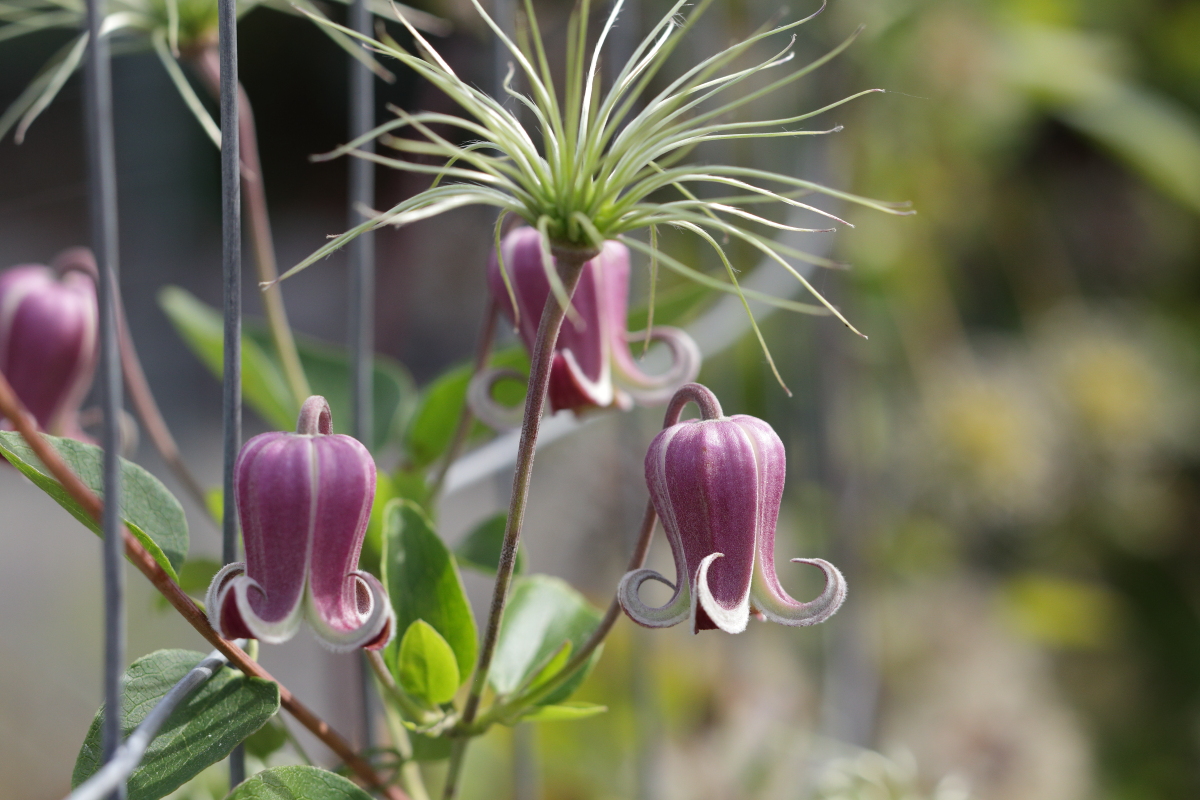
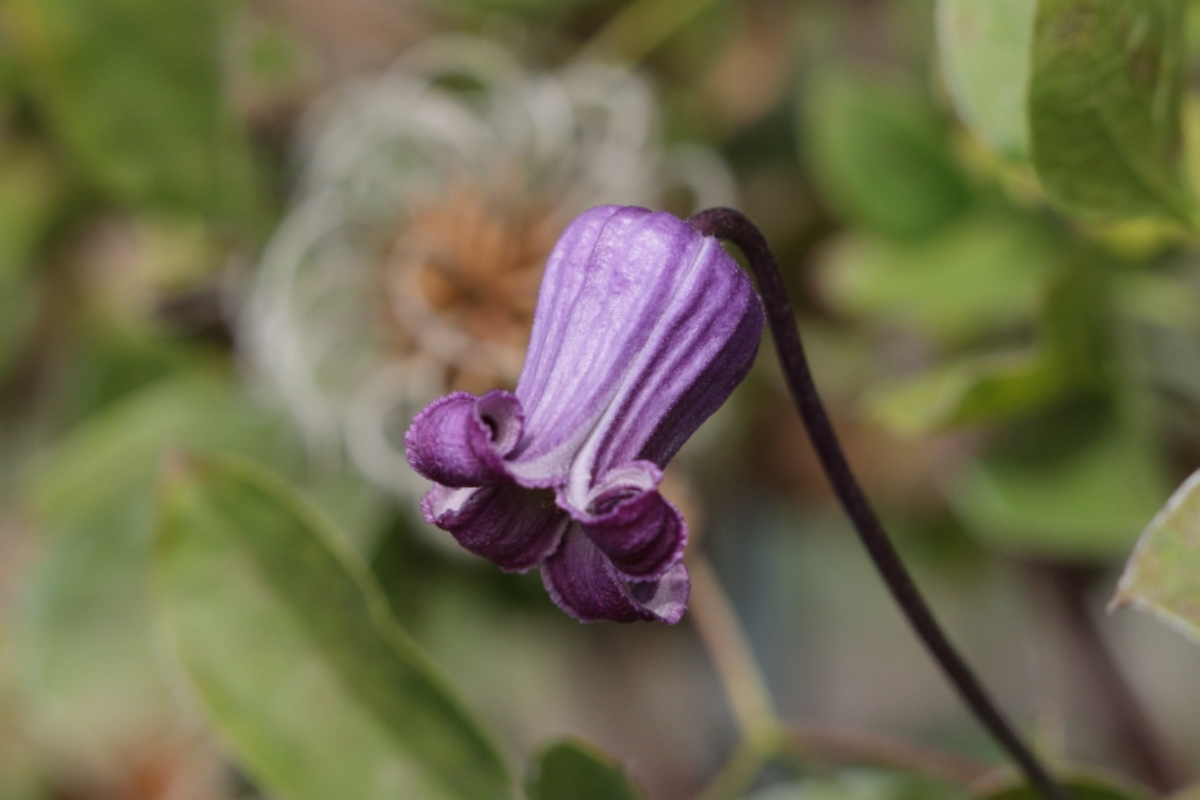
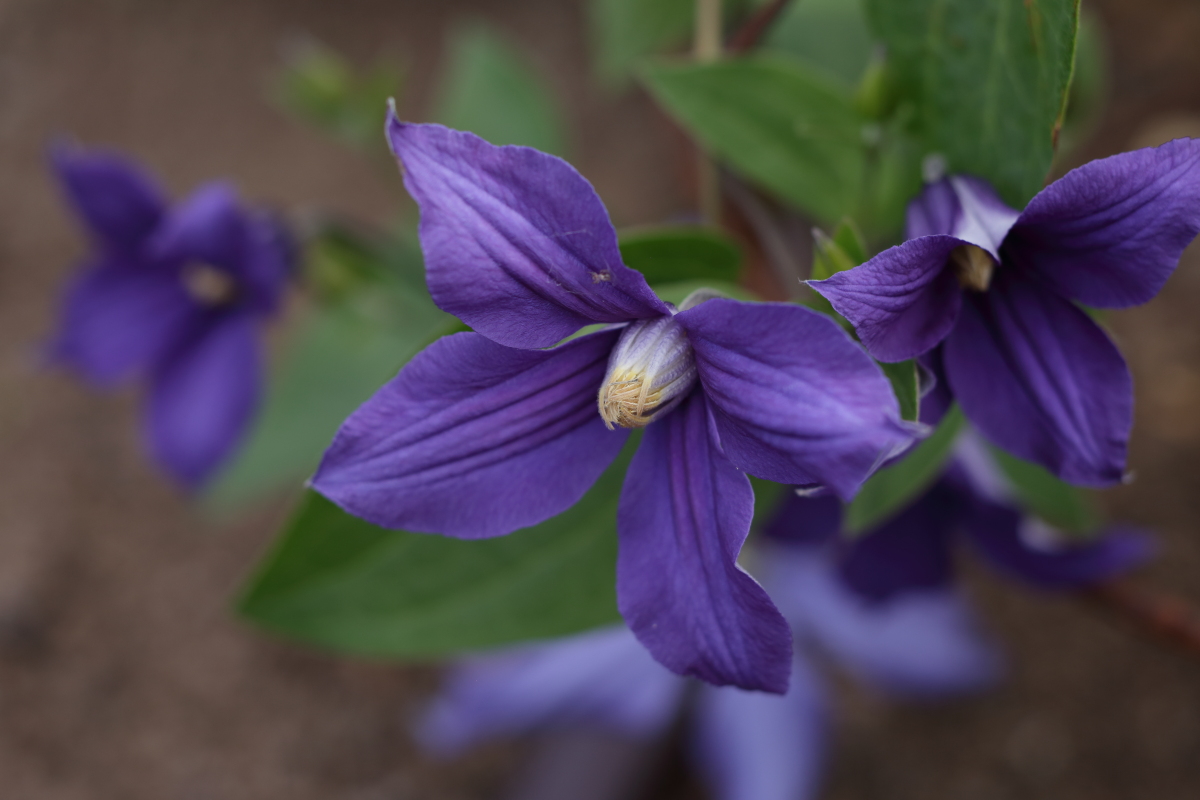
The American species in the clematis Viornae Group are pollinated by hummingbirds. These New World birds, with their long bills and tongues, have no trouble piercing the dense plug of pollen-bearing stamens (and pistols) that jam the opening of the urn-shaped blooms like those of the seedling pictured here. They easily reach the nectary chamber at the base of the filaments, and indeed, a pair of Anna’s Hummingbirds hang around the test plot, feeding on the Viornae seedlings we are evaluating. As they feed, their beaks and foreheads are liberally dusted with pollen. At Luscher Farm we are blessed with healthy populations of European honeybees, but they are completely flummoxed by this group of clematis.

The bees seem to know there is nectar in these blossoms, but there isn’t room for them to crawl up into the flower—the bees are too big, and the stamens too tightly packed. Undaunted, the bees attempted to separate the seams between the sepals, using forelegs and mouth parts to try to pry an opening to access the nectar. I watched their efforts for about 10 minutes before realizing I should be taking pictures! During the time I observed the honeybees, I didn’t see any of them succeed in opening the sepal edges, and was surprised that the bees would expend so much energy trying. A couple of rows away, native bumblebees were feasting on a Clematis macropetala seedling’s flowers (the same plant that Killdeer’s nested under a year ago), an open bell much easier to navigate in, and a flower not exploited by the hummingbirds.

Why would so many non-native bees be trying so hard to crack these clematis blooms? I did detect a slight fragrance, but there are many easier plants to drink from nearby. If these bees are ever successful at opening clematis in this nontraditional way, I’ll let you know.

Making New Clematis From Elderly Container Plants

Posted by LindaB on Sunday, July 22, 2007

Long Division: Making New Clematis From Elderly Container Plants
by Linda Beutler, curator

At the Rogerson Clematis Collection there is hardly anything more satisfying for a volunteer to learn than how to save an ailing old containerized clematis from certain death, and to end up with several rejuvenated plants when you started with one.

It is now pretty widely known that until its arrival at Luscher Farm, the Rogerson Clematis Collection plants were all grown in containers, and housed in poly-covered houses at a wholesale nursery. For the largest part of the collection’s life, Brewster amassed the plants in isolation, with only limited help from work crews at the nursery when manpower for extensive weeding or pruning was necessary. Brewster did the daily tending—watering, fertilizing, grooming, repotting, root pruning—himself. Remarkable, when you think about it.

When Brewster did recruit volunteers, the initial charge for all of us was to help get the collection back into shape by pruning, tying up, isolating seedlings, and figuring out, where possible, why some clematis entered a sudden and precipitous decline. Brewster always insisted on the same process, to haul sickly plants to the potting bench to “have a look inside”. He instilled in all of us a certain fearlessness for examining clematis roots, and we, in turn, came to understand the alarming if distinct life-cycle of clematis kept too long in containers.

You see here an image of a soil type we call “wet chocolate cake.” After two to three years in the same pot, even the best potting soil will decline to this state. Over time soil structure breaks down. Small particles hold water without admitting air because larger chunks, bark or perlite or pumice, degrade as water continually passes through them. Peat-based soil is particularly notorious. Drainage becomes poor.

Should soil in this state dry completely, the only way to rehydrate it is to plunge the container into water and soak it until it sinks. Without plunging, the water will flow down the outside of the root ball, next to the pot wall. If soil in this state is already thoroughly wet, the result when watering is the same, the only sharp drainage is at the outer edge of the root ball. In either case, the clematis roots flee the center of the soil, and grow to the edges, working their way around the interior pot wall, where they are vulnerable to overheating if sun shines directly onto the pot. Now you have “twice-cooked clematis,” steamed if too wet and hot, fried if too hot and dry.

The behavior of a large-flowered hybrid, viticella hybrid, or most atragenes (C. alpina, macropetala, and their cousins and hybrids) in this type of soil environment is predictable. Clematis show the first stages of decline by abandoning old wood (which planted in a garden might live, becoming trunk-like, for 10 or 20 years) and producing a proliferation of spindly new growth, perhaps even displaying a mass of smaller than expected blossoms. This can be impressive, like the last beautiful aria of Tosca. Each scrawny stem usually represents a new crown, produced just below or at the soil surface. This is the plant’s attempt to create new growth nearer a hospitable environment. Often the roots of these new crowns emerge to the surface, run to the edge of the pot, then down the sides, where water flows and the air-to-water ratio is better. The interior roots of the plant are rotting.

If unnoticed and unattended, the clematis has less than a year to live. This may sound overly dramatic, but there it is. These young crowns are not likely to survive the next winter. The unrelenting soggy soil, coupled with cool temperatures, will spread the interior root-rot throughout the soil. The proliferation of crowns is a last attempt to live.

Clematis with nothing left but surface roots are more susceptible to being choked by weeds. As we work through the collection, attempting to control tenacious weeds such as oxalis and violets, we can assess the overall health of a plant by a few telling characteristics. If we move the pot and it is bottom-heavy prior to being watered, the soil is holding too much water and may be failing. If a plant we know to be big and boisterous is suddenly sparse and new growth lanky, we know what we’ll find if we tip it out of its pot: wet chocolate cake. If roots and crowns are visible at the surface, the clematis wants immediate help. NOW!

We follow these steps when treating such plants:

1. Prune the clematis back to 12 to 24 inches tall. Remove any damaged leaves. Ailing clematis often show sunburn when they never did before. This is another diagnostic indicator.

2. Remove the signage on the plant and set it aside.

3. Supporting the stems at soil level between outstretched fingers, with the other hand tip the plant nearly upside down and slide it out of the pot.

4. The soil will look and feel like wet chocolate cake, and will smell rancid, moldy, and in extreme cases will reveal patches of white mildew.

5. Sometimes the soil may fall away when you shake the crown, but usually it sticks like glue. Work as much of the soil off the roots and crowns as you can. Pointed chopsticks are invaluable for this purpose.

6. Once you have removed as much soil as you can by this method, it is usually also necessary to bath the roots to remove the final coating of soil so that all crowns are clearly visible.

7. Pull away any obviously rotten or disconnected roots.

8. If the root mass is, in its entire state, fairly full and long, cut the roots back by not more than about a third their length. If the root mass it skimpy, do not prune at all, and try to salvage as much of it as you can as you go to the next step.

9. Start wriggling the crowns apart, starting with those around the outer edge of the original crown, and working toward the center. You will damage a few roots, and roots rotten at the crown will pull apart. Don’t be brutish, but extreme gentleness is not required. It is amazing how much inept manipulation these plants will tolerate.

10. It may be necessary to clip crowns apart from umbilical-like cords of old woody crowns. Just make sure every new crown you separate has a nice tuft of roots of its own.

11. Once in a while two crowns are so closely linked and intertwined that they cannot, and maybe should not, be separated.

12. Once all of the crowns are apart, prepare new labels for each, and decide what size container each should go into. Use fresh, free draining potting soil. You also have the option of taking two or three small crowns and potting them together. Finish with a drink of transplant liquid, half strength, or a light soil application of slow-release rose and flower food.

13. DO NOT OVER POT, meaning placing a new plant in a pot much too large for it. It will stay too wet in soil it doesn’t have enough roots to exploit. Likewise, do not plant newly divided clematis directly into the ground. Let them live in a pot until their roots fill it up, which may take four to six weeks.

In the final image, you see the results of a morning’s work, and how many new plants were created from five desperate clematis. The plant shown being divided, by the way, was ‘Maria Louise Jensen’.