Propagation From Cuttings: How We Do It

Posted by LindaB on Tuesday, October 20, 2009

Here at the Rogerson Clematis Collection we have a lot of combined experience in clematis propagation. Our board President, Sally Geist, is a long time practitioner of clematis propagation by semi-hardwood cuttings and from seed. Of course we have Brewster’s experience to draw upon, and in the summer of 2008 we had an avid intern who tried many methods and media. Sally and I learned even more on our visit to Japan with the International Clematis Society, also in the summer of ‘08. Sometimes tricks are needed, and an example is knowing, thanks to Mikioshi Chikuma of Japan, that Clematis integrifolia and its near hybrids are more successfully propagated when tip cuttings are used instead of older semi-hardwood.

We’ve learned that timing can be quite different for each horticultural group. For large-flowered hybrids, for instance, our best success is using stems that are about to bloom. This seems heartless, but their growth hormone is highly concentrated in the stems then, and even difficult cultivars are easier. With montanas, nearly anytime of year after the leaves have matured but before they fall in the autumn is okay. In any case, cuttings should be taken from young healthy plants.

Through trial and error we have begun using deep “tomato plug trays” to hold the cuttings, and each tray it set into a plastic flat lid used in this case to hold bottom water. The plug tray is filled with straight propagation-grade perlite. Internodal cuttings are cut to be, ideally, 2.5 inches (6.25 cm) long, so that the cut end is well down into the perlite and the leaf node sits right at the surface, to stay moist. We use Wood’s Rooting Compound as our hormone. It is a formula developed by Ed Wood, a bonsai specialist who had a nursery in Aurora, Oregon. It does not need refrigeration, and the type of alcohol he used as a base, a proprietary secret, allows a pint container of the concentrate to last about a year, making it less perishable than the other liquids on the market. It works much better than any of the powders.

A maximum of three cuttings are stuck into each plug, and the water level in the clear trays is kept to one inch (2.5 cm) deep. We have rigged a screen to spare the cuttings from hot afternoon sun. Other than keeping the water level steady, once the cuttings are stuck, we do not trouble them for six weeks, except to pull out cuttings that have shriveled. We use bottom heat, both electric mats and cables, at 70F.

After six weeks, we start tugging, and using a pointed chopstick to slide down the wall of the plug and lift the cuttings out. Below is a picture of two perfectly rooted cuttings of Clematis ‘Brewster’. Well-rooted cuttings like these should be moved on to a “weaning” medium immediately, as they aren’t getting any fertilizer from just the water and perlite. Any perlite attached to the roots from the plugs is left there undisturbed. The weaning medium is 50% perlite + 50% coconut hull fiber (syn. coir), and this is moistened. We plant the cuttings into 5″ deep band-bottom pots (2-3/8 inches square), and top this mix with 1/4 inch of number 2 grade chicken grit (number 1 is too fine). The pots are packed into deep flats and put back on the bottom heat. After the cuttings have had a week to recover from this transition, we begin giving them 1/3 strength fish fertilizer (5-1-1) to encourage top growth. They get 1/3 strength fish fertilizer once a week until top growth is vigorously emerging.

Cuttings of Clematis 'Brewster'

When the roots have filled this size pot, they will move into #1 (syn. 1-gallon) plastic pots, and hopefully new leaves and shoots are developing along with the roots. Once in these “finishing” pots, the clematis are removed from bottom heat. They will be ready to plant or sell in another year. We will sell no clematis before its time!

Potted Clematis Cuttings

FRCC offers a propagation class every summer, usually in late July, which we have found to be the optimal time to take cuttings for many types of clematis. If you volunteer at the collection, you may be pressed into service as a clematis propagation assistant at any time! At the advice of nurseryman Bob Gutmann, we will be taking cuttings from the New Zealand hybrid evergreen clematis (such as C. x cartmanii ‘Sweet Hart’) in another month (mid-November). We’ll post more pictures then!

October 2009 Bloom Report

Posted by LindaB on Wednesday, October 7, 2009

What with having quite a full dance card for September, our bloom report got skipped, so the Tangutica/Orientalis group go sadly unsung. However, we are having our usual gorgeous autumnal weather, foggy mornings burning through to glorious and comfortable afternoons, and crisp nights. Most of the large-flowered hybrids love it, and are enjoying a second spring. Please notice that ‘Betty Risdon’ is on the list again. This is the plant that was our award winner for broadest blossom last spring. The plant was hard-pruned divided this summer, yet here it is again, nearly as big. So much for the theory that large-flowered hybrids heavily pruned in mid-summer will produce smaller flowers in autumn. ‘Tain’t so!

Greenhouse:
‘Andrew’
ARCTIC QUEEN
‘Bells of Emei Shan’
‘Betty Risdon’
BIJOU ‘Evipo030′ (1.2 meters tall, after the recommended “ponytail cut”)
‘Blue Light’
‘Dorothy Tolver’
‘Duchess of Waverly’
‘Gabrielle’ (waiting for verification if this is Polly Hill’s version or European)
‘Horn of Plenty’
‘Kathleen Dunford’
‘Margaret Hunt’
‘Maria Louise Jensen’
‘Masquerade’
‘Natascha’
‘Sally Cadge’
‘Summer Breeze’
‘Sunset’
VERSAILLES
‘Will Goodwin’

Clematis 'Betty Risdon'

Outdoor Storage Area:
‘Aotearoa’
‘Fond Memories’
‘Fryderyk Chopin’
HARLOW CARR ‘Evipo004′
INSPIRATION ‘Zoin’
‘Niobe’
‘Piilu’
‘Prince Charles’
‘Romantika’
‘Sodertalje’
‘Sympatia’
‘Voluceau’
‘Westerplatte’

Terrace Walk:
C. cirrhosa ‘Jingle Bells’
C. cirrhosa ‘Ourika Valley’
C. cirrhosa var. purpurea ‘Freckles’
C. cirrhosa var. purpurea ‘Lansdowne Gem’
‘Southern Cross’ (yes, there are a few blooms, but it also has mildew

Founder’s Garden:
‘Arabella’
‘Duchess of Waverly’
‘Esprit’ (has been blooming all summer—really!)

Beech Tree’s Garden:
‘Frau Mikiko’
‘Fudo’
‘Roguchi’ (beautiful with its maple, Acer ‘Sangu Kaku’)
C. terniflora
C. terniflora ‘Variegata’

Clematis 'Roguchi'

Historic Garden:
Bed B
Clematis crispa (nearly white form)
‘Fairy Queen’
‘Ramona’

Bed C
‘Belle Nantaise’ (as you see, not open enough yet to show the “Nantaise droop”)
‘Daniel Deronda’
C. heracleifolia
‘Madame Baron-Veillard’
‘Royal Velours’

Clematis 'Belle Nantaise'

Bed D
‘Etoile Violette’
‘Lady Betty Balfour’

Bed F
‘Lawsoniana’

Bed G
‘Mrs. Cholmondeley’

Bed H
‘Candida’
C. crispa (typical form)
‘Perle d’Azur’
‘Proteus’

Front Bank:
‘Gravetye Beauty’
‘Lady Bird Johnson’
‘Queen of Holland’
C. texensis

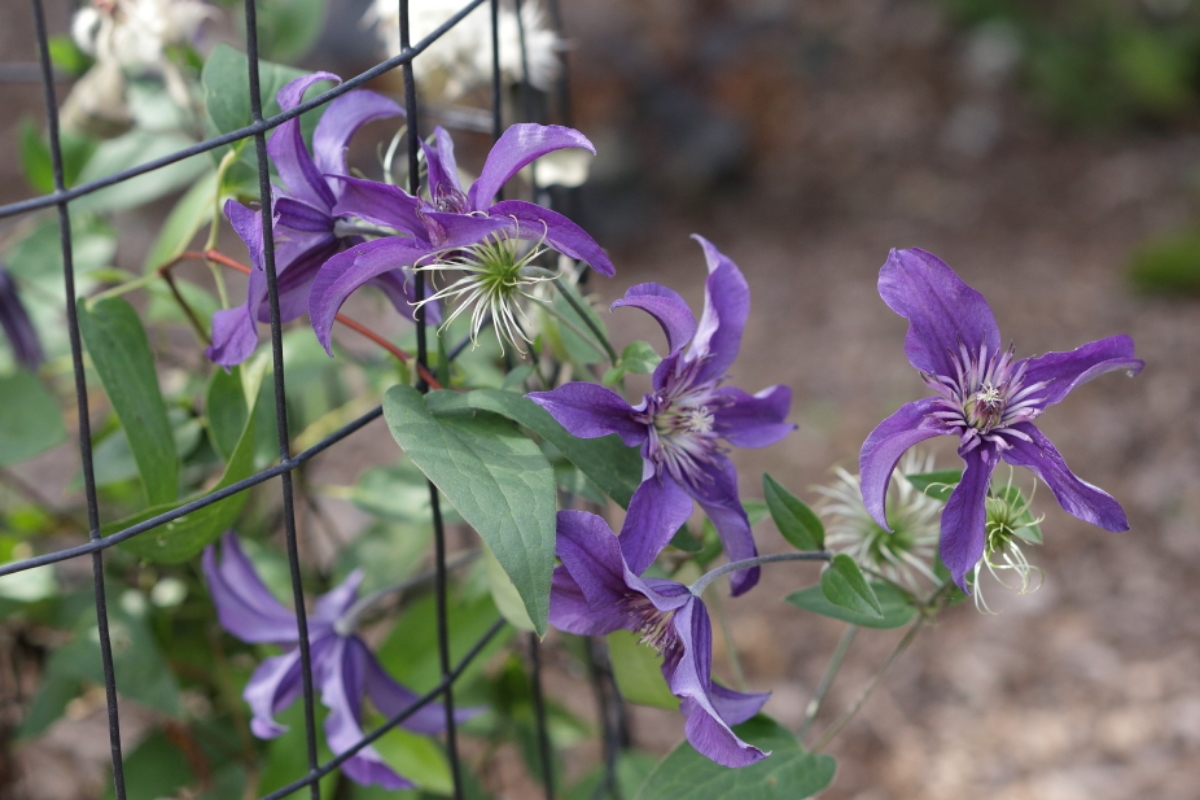
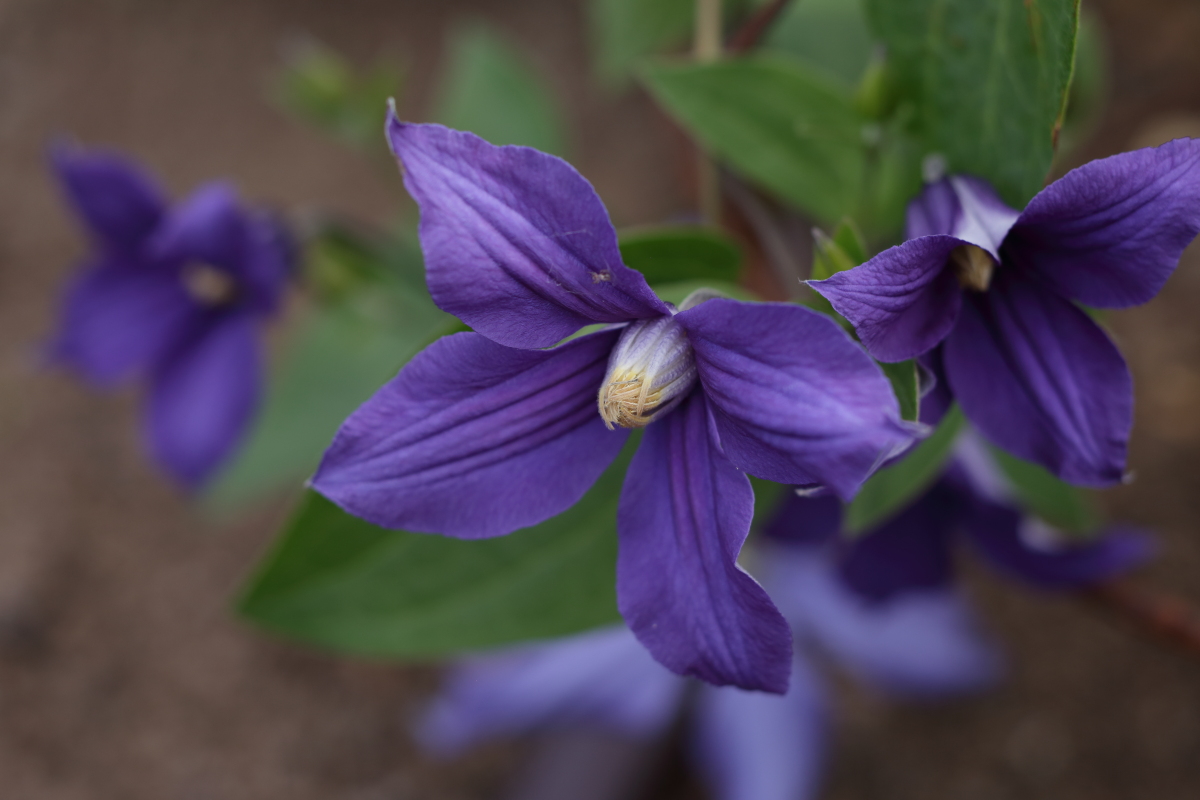
Last but not least: in the test plot we have some very interesting seedlings. The one pictured here, named ‘Honcho’ by Brewster, is a sibling of our Integrifolia Group introduction ‘Skylark’. The term honcho is American slang for someone large and in-charge, as in “Who does he think he is, the head honcho?” Notice the broad sepals, mid-blue color, and large foliage. We will be registering and introducing this plant soon.

Clematis 'Honcho'